The Truth About Retail Cactus Soil
However, beneath the surface of that dark, damp soil, a silent chemical and biological catastrophe is often unfolding.
In the horticultural industry, we call this “Bag Rot.” While the packaging promises a balanced environment for your desert plants, the reality of the global supply chain often delivers a product that is biologically stagnant, chemically unstable, and structurally detrimental to slow-growing specimens.
01 // The Illusion of Quality: What is “Bag Rot”?
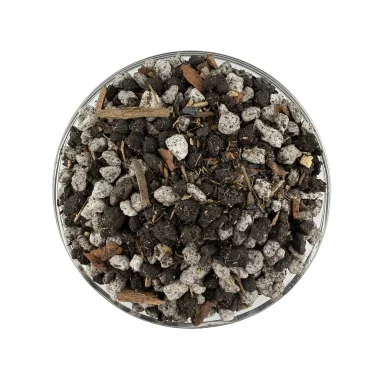
Most commercial cactus soils are composed primarily of peat moss, forest products (wood mulch), and a small percentage of perlite. While these ingredients are inexpensive to source, they are fundamentally incompatible with the long-term health of desert flora when stored in sealed plastic bags for months at a time.
The Anaerobic Nightmare
When you open a bag of soil and notice a sour, metallic, or “swampy” smell, you are witnessing the aftermath of biological collapse. These anaerobic conditions produce byproducts that are toxic to plant roots:
- Methane gas and Hydrogen sulfide.
- Organic acids (like acetic and butyric acid) that “melt” fine root hairs.
When a sensitive cactus root—evolved to thrive in the porous, oxygen-rich minerals of the high desert—is placed into this environment, it doesn’t just “fail to grow.” It suffers from chemical burns and oxygen deprivation.
02 // The “Shelf-Life” Problem: Why Warehouses are Soil Graveyards
The journey from the manufacturing plant to your potting bench is often a long one. Commercial soil mixes may sit in shipping containers, hot warehouses, or outdoor garden center pallets for six to eighteen months.
1. The Moisture Trap
To prevent dust, manufacturers bag soil with “process moisture.” In a sealed bag, this moisture saturates the organic matter, accelerating decomposition. By the time you buy it, the “soil” has already begun to rot.
2. The pH Crash
As peat moss decays, it releases humic acids that neutralize the lime buffers added by the manufacturer. The pH can plummet from a healthy $6.5$ to a caustic $4.0$. This “pH Crash” causes nutrient lockout, effectively starving your plant while simultaneously poisoning it with hyper-soluble heavy metals.
03 // The Drainage Deception: Why “Cactus Mix” Still Drowns Roots
Even if you find a “fresh” bag of soil, the physical architecture of the medium is often fundamentally flawed. Most commercial brands use a base that is 80–90% organic “fines”—tiny particles of peat and forest mulch.
The Sponge Effect
In the wild, cacti grow in mineral-rich scree where water moves through the root zone in seconds. Store-bought soil acts like a synthetic sponge.
- High Water Retention: Peat moss can hold up to 20 times its weight in water. For a desert plant, this creates a “cold, wet blanket” effect that lasts for weeks after a single watering.
- Lack of Macroporosity: Because the particles are so small and uniform, there are no “air pockets.” Roots need oxygen to perform cellular respiration; without it, they suffocate and succumb to fungal pathogens.
04 // The Rescue Mission: Why Amendments are Non-Negotiable
If you must use store-bought soil, it should never be used “straight out of the bag.” To save your plants, you have to perform a mechanical intervention by adding inorganic amendments. At LANDIRIS, we view these not as “extras,” but as the primary structure of a healthy root environment.
1. Pumice: The Gold Standard for Aeration
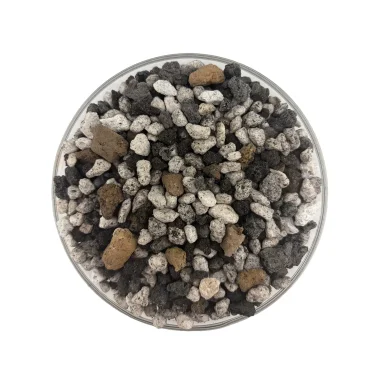
Pumice is a volcanic rock filled with tiny gas bubbles. Unlike perlite, it doesn’t float to the top or crush over time.
- The Benefit: Adding 50% pumice to a store-bought mix shatters the “sponge effect.” It creates permanent channels for air and allows excess water to gravity-drain instantly.
2. Calcined Clay: Managing the Moisture Curve
Calcined (fired) clay particles act as internal reservoirs. They take in moisture and release it slowly back to the plant without making the surrounding soil “mushy.”
- The Benefit: It provides the “grit” necessary for root anchoring while ensuring the soil doesn’t turn into a hydrophobic brick when it finally dries out.
3. Breaking the “Hydrophobic” Barrier
Ironically, while peat-based soils hold too much water, once they dry out completely, they become hydrophobic. Water will simply run down the inside of the pot, leaving the root ball bone-dry. Large-particle amendments like pumice and lava rock ensure that water can actually penetrate the root zone every time you water.
05 // The Time-Release Gamble: Why Synthetic Fertilizers Fail Cacti
Most commercial “Pro-Mixes” come pre-loaded with synthetic fertilizer prills. These are a “biological bomb” for slow growers.
- The Overdose: High temperatures cause these prills to “dump” their entire nitrogen load at once.
- The Result: Bloated, weak growth that is a magnet for mealybugs and scale.
Professional collectors prefer “lean” mineral mixes, allowing them to control nutrition through diluted, cactus-specific liquid fertilizers during the active growing season.
06 // The Price of “Convenience” Soil
The convenience of a $10 bag of soil is a mirage. When you factor in the cost of losing a prized specimen—not to mention the years invested in its growth—the “cheap” soil becomes the most expensive component of your hobby.
Your cacti are survivors of some of the harshest environments on Earth. They are designed to withstand drought and nutrient-poor minerals. What they are not designed to survive is the suffocating, acidic, and fermented environment of a degraded, peat-heavy bag of store-bought soil.
Stop treating your desert gems like tropical houseplants. By amending your soil with pumice and clay—or switching to a fully mineral substrate—you are finally giving your plants the one thing they crave: a place to breathe.
07 // Buy Only What Your Plants Need
Soil Volume Projector
Multi-unit requisition featuring 2QT and 4QT bag logistics.